Free · No sign-up · Runs on your phone
Jawline Rating: Free Jawline Test From One Photo
Get a jawline score out of 100 and see how your jaw compares with your cheekbones, chin and lower face. One front-facing photo is enough.
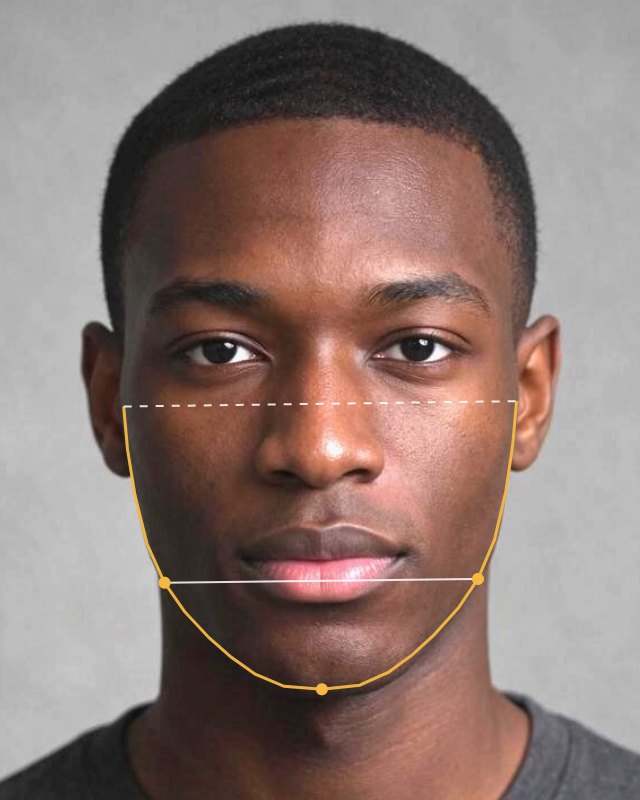
Example on an AI-generated face
- Chin level, not raised
- Hair off the jaw
- Phone at eye height
Your photo never leaves your device.
By continuing you confirm you're 18 or older and this is a photo of you, or of someone who has given you permission. We save only your scores, anonymously.
Checking your photo
Loading the face model…
- Load model
- Find your face
- Measure
Runs on your phone — your photo isn't uploaded.
No score yet
Let's try another photo
Definition
What does a jawline rating measure?
Your jawline is the lower outline of your face, running from just under each ear down to your chin. A jawline rating puts numbers on how that outline is built: how wide the jaw is compared with the cheekbones, how sharply it turns toward the chin, how tall the chin is, and whether both sides match.
There is no single correct jawline. A wide, square jaw and a narrow, tapered one are both common. What this tool tells you is where your measurements sit compared with most adult faces.
Method
How this jawline test reads your photo
- Map the face. Google's open-source MediaPipe Face Landmarker places 478 points on your photo, including a chain of points along the jaw from each cheekbone to the chin.
- Width. The distance between the two jaw corners is divided by the distance between the cheekbones. Most faces land between about 0.78 and 0.82.
- Angle. At each jaw corner the test measures the angle between the line up to the cheekbone and the line down to the chin, then averages the two sides.
- Lower face and chin. The lower third of the face, from the nose base down to the chin tip, is measured as a share of face height. Chin height is compared with the gap between the nose and the upper lip.
- Balance. The two jaw corners and the two cheekbones are checked for the same height and distance from the centre line.
- Combine. Width, balance, lower-face proportion and chin height each get a score out of 100. Your jawline score is a weighted average, with width counting most.
Reading the number
Is my jawline good? How to read your jawline score
| Jawline score | What it means |
|---|---|
| 85–100 | Balanced jawline. Width, chin and lower face all sit inside the range most people share. |
| 60–84 | Typical jawline. One or two measurements sit a little outside the middle of the range. |
| Under 60 | Less even in this photo. Check head angle, light and expression before reading anything into it. |
The jaw angle is shown next to the score but does not change it. Angles in the middle half of our sample ran from about 130 to 134 degrees in a front view. Below that reads as more angular, above as softer. Both are normal.
Limits
What a front photo cannot tell you about your jaw
The jaw measurement most people have heard of is the gonial angle. A 2026 study comparing ways of measuring it describes it like this:
The gonial angle is an important cephalometric parameter used to assess mandibular morphology and vertical facial growth.
The same study notes that it is usually measured on side-view skull X-rays and panoramic dental X-rays. A selfie shows neither view, so here is what stays out of reach:
- The side profile. Gonial angle, chin projection and the ear-to-chin line are all side-view measurements. A front photo cannot see them.
- Soft tissue. Landmarks sit on the visible outline. They cannot separate bone from muscle, fat or skin, so the same jaw can read differently after weight changes.
- Jaw edge contrast. How crisp the jaw looks against the neck depends on shadow, which the points do not measure.
- Beards and hair. Hair over the jaw moves the outline the model sees. Results with a full beard describe the beard shape as much as the jaw.
Common misreadings
Why your jawline looks different from photo to photo
- Chin height. Raising the chin shortens the lower face on camera. Lowering it tucks the jaw corners into the neck. Keep it level.
- Camera height. A phone held below the face makes the jaw look broader and heavier; at eye height it reads true.
- Lens distance. Arm's-length selfies stretch whatever is nearest the lens. Stepping back and zooming in slightly gives a flatter, more accurate outline.
- Posture. Leaning back folds the skin under the chin into the jaw line. Bringing the head slightly forward separates them.
- Expression. Clenching widens the jaw muscles for a moment; a wide smile pulls the cheeks down over the corners.
Jawline and face shape
How your jawline shapes your face shape
Jaw width is one of the main signals that separate face shapes. A jaw close to the cheekbone width points toward a square or round outline; a jaw that narrows clearly points toward a heart or oval one. That is why the same width ratio also feeds the face shape and hairstyle directions in our full attractiveness test, which reads it alongside symmetry and facial thirds from the same photo. The face shape detector shows your full shape.
Questions
Jawline rating FAQ
What is a good jawline score?
Most front photos we measured land between about 66 and 92 out of 100, with the middle near 84. If your jawline score is 85 or more, your jaw, chin and lower face sit close to the range most people fall in. Your jawline score describes balance in one photo. It is not a grade on your looks.
Is my jawline good?
If your jawline score is 85 or higher, your jaw, chin and lower face sit inside the range most adults share, which is what people usually mean by a good jawline. A lower number from one photo is a reason to retake the picture first. Jaw shapes that differ from the middle of the range are common, and none of them needs correcting.
What makes a jawline look strong or defined?
In photos, a strong jawline and a defined jawline usually come from the same three things: a jaw that is close to the width of the cheekbones, corners that turn at a clear angle, and a visible edge between the jaw and the neck. The first two are what this jawline test reads. The edge depends heavily on light, posture and how the head is held.
Can a front photo measure the gonial angle?
No. It is the angle at the back corner of the jaw, and it is measured from the side. A front photo shows a different angle: how sharply the jaw turns from the cheek toward the chin. We report that front-view angle and say clearly which one it is.
Why is my jawline rating lower than I expected?
Your jawline score usually drops because of a raised or lowered chin, a slight head turn, hair over the jaw, or a close-up lens that widens the lower face. Retake the photo with the phone at eye height, chin level and hair pulled back, then compare.
How can I get a sharper jawline in photos?
Hold the phone at eye height or slightly above, push the head forward a little so the jaw separates from the neck, and use light that comes from the front or one side. Beard shape and hairstyles that end below the jaw also change how defined the outline looks. Changes to bone structure will not show up between photos taken days apart.
Is the jawline rating different for men and women?
The measurements are the same for everyone, and the reference ranges come from a mixed set of adult faces. On average men in our sample had slightly wider jaws relative to the cheekbones, so the width item reads both directions as normal variation rather than marking one as better.
Is this jawline test free and private?
Yes. The jawline test is free and needs no account. Your photo is measured on your own device and is never uploaded. We keep only the numbers, such as the width ratio and the score, with nothing that identifies you.
Rate my jawline now
Take one level, front-facing photo with your hair off the jaw. The jawline rating, the four measured items and your jaw angle appear in a few seconds.
By How Attractive Am I · Last updated