Free · No sign-up · Runs on your phone
Face Symmetry Test: How Symmetrical Is My Face?
See how closely your left and right sides mirror each other, area by area. Use a straight-on photo: even a small head turn changes the result.
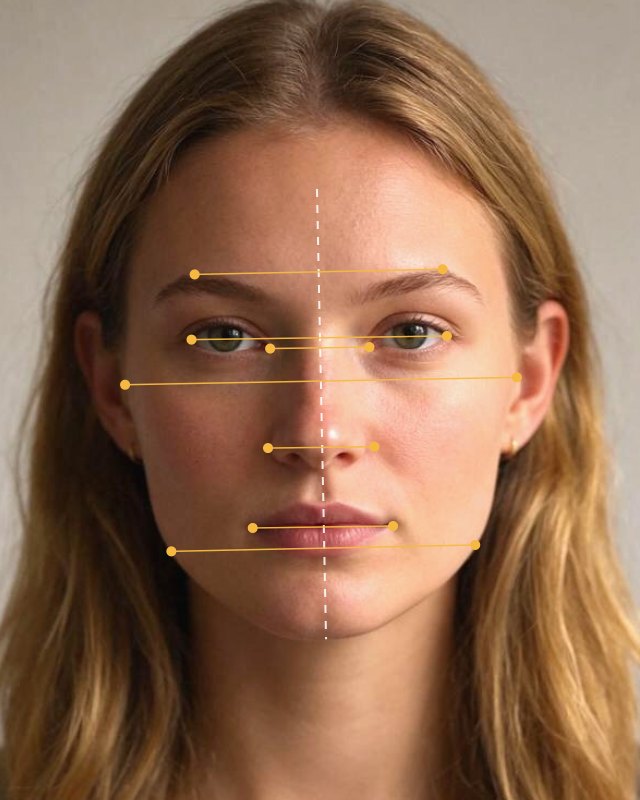
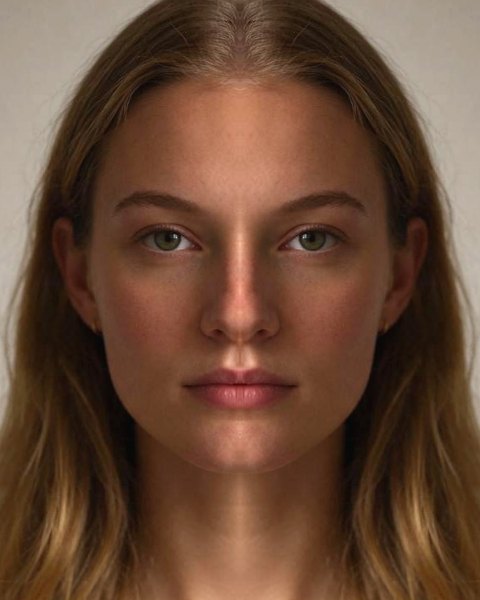
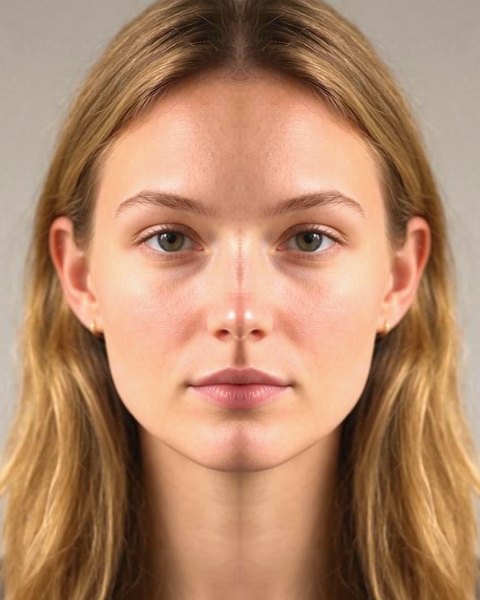
Example on an AI-generated face
- Look straight at the lens
- Head level
- Even light
Your photo never leaves your device.
By continuing you confirm you're 18 or older and this is a photo of your own face. We save only your scores and measurements, anonymously.
Checking your photo
Loading the face model…
- Load model
- Find your face
- Measure
Runs on your phone — your photo isn't uploaded.
No score yet
Let's try another photo
Definition
What is face symmetry?
Face symmetry is how closely the left half of your face mirrors the right half across a vertical line that runs from your forehead through the bridge of your nose to your chin. If you folded a perfectly symmetrical face along that line, every feature would land on its twin.
Real faces never do that exactly. Eyes sit at slightly different heights, one eyebrow arches more, the nose leans a fraction, one corner of the mouth lifts first. Biologists call these small, random left-right differences fluctuating asymmetry, and everyone has them. A face symmetry test measures how large they are in one photo.
Method
How this face symmetry test measures your photo
- Map. A landmark model places 478 points on your photo.
- Straighten. The points are three-dimensional, so the test first turns your head upright and square to the camera. A small tilt or turn is corrected before anything is compared.
- Find the centre line. Seven points down the middle, from forehead to chin, set the line your two sides are compared across.
- Compare matching points. For each left-right pair, such as the two outer eye corners, the test checks whether both sit at the same height and the same distance from the centre line. The gap is expressed as a share of your face width, so photo size does not matter.
- Score five areas. Eyes, eyebrows, nose, mouth, and jaw with cheekbones each get a score out of 100. Your symmetry score is their average.
Reading the number
How to read your symmetry score
| Symmetry score | What it means |
|---|---|
| 85–100 | Closely mirrored. Matching points sit almost exactly opposite each other. |
| 60–84 | Well matched. The two sides line up, with the small differences every face carries. |
| Under 60 | More difference in this photo. Check the pose, light and expression, then compare with a second shot. |
The bands describe one picture. A face symmetry test taken on a different day, in different light, can land in a different band. They are not grades, and there is no pass mark.
Mirror test
The mirrored-halves test: left-left and right-right
Alongside the score, this symmetrical face test builds two extra images. One takes the left half of your photo and mirrors it into a whole face. The other does the same with the right half. Both are made on your device.
The two versions often look like siblings instead of the same person. That is expected: mirroring doubles every small difference on one side, so a slightly wider jaw or a higher brow becomes the whole face. Hair and lighting get doubled too, which is why a side-lit photo gives one bright version and one dark one.
Fully symmetrical composites can also look a little unfamiliar, because the faces we see every day are never that even.
Common misreadings
Why a face looks less symmetrical in photos
- Head turn. Turning even slightly makes the near side look wider. The test corrects small turns and asks for a new photo when the turn is large.
- Lens distance. A phone held close enlarges whatever is nearest, usually the nose and one cheek.
- Side light. A shadow down one side hides the true edge of the jaw and cheekbone.
- Expression. Smiles, raised brows and a half-closed eye are rarely even. A relaxed, neutral expression gives the steadiest reading.
- The flip. Photos are not mirrored, so your own face looks unfamiliar compared with what you see every morning.
Symmetry and looks
Does face symmetry make you more attractive?
Partly. Gillian Rhodes's 2006 review in the Annual Review of Psychology, The Evolutionary Psychology of Facial Beauty, found that symmetry is attractive in both male and female faces and across cultures. The same review found the same for two other cues: averageness, meaning how typical a face's proportions are, and sexual dimorphism.
So face symmetry is one ingredient among several. And because no face is perfectly symmetrical, that includes the faces people rate as most attractive.
That is why symmetry is only one of seven measurements in our full attractiveness test, which also reads facial thirds, eye spacing, jaw shape and more from the same kind of photo.
Questions
Face symmetry FAQ
Is my face symmetrical?
Nobody has a perfectly symmetrical face, so the useful question is how close the two halves are. This face symmetry test answers it with a number out of 100 and shows which of five areas match most closely. Small differences between left and right are part of every human face.
Am I symmetrical enough? How much asymmetry is normal?
If you are asking "am I symmetrical", some difference between the two sides is the normal state. One eye sits a touch higher, one brow arches more, the mouth pulls slightly to one side when you talk. A score in the middle band means your halves match well. A lower number from a single picture mostly reflects the pose, the light or the expression in that shot.
Why does my face look more symmetrical in the mirror than in photos?
You are used to your mirror image, which is flipped. A camera shows you the way other people see you, so the familiar small differences land on the opposite side and stand out. A 1977 study by Mita, Dermer and Knight in the Journal of Personality and Social Psychology found that people tend to prefer their mirror image while their friends prefer the true image. Close-up lenses also stretch whichever side is nearer.
Can I make my face look more symmetrical?
In photos, yes. Face the lens squarely, keep your head level, light both sides evenly and relax your expression, then run the symmetrical face test again. Hair parting, brow grooming and glasses that sit level also change how even a face reads. One reminder: if the symmetry of your face changes suddenly, it is a good idea to see a doctor promptly.
How accurate is a facial symmetry test from one photo?
A facial symmetry test from one photo is repeatable: the same image always gives the same symmetry score. What it cannot do is separate your real structure from the way the picture was taken. A slight head turn or uneven light lowers the number, which is why the result tells you when the shot looks angled and suggests another one.
Is this symmetry test free and private?
Yes. The symmetry test costs nothing and needs no account. The measuring happens on your own device, the mirrored images are drawn there too, and the photo is never sent to us. We keep only the numbers, with nothing that identifies you.
Check your symmetry now
One level, well-lit photo is all the face symmetry test needs. You get the score, the five-area breakdown and both mirrored versions in a few seconds.